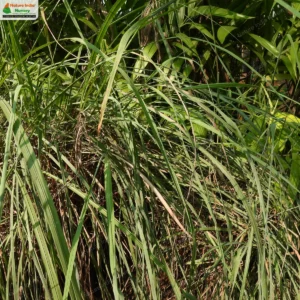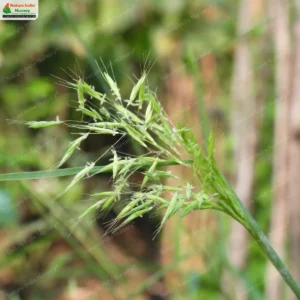
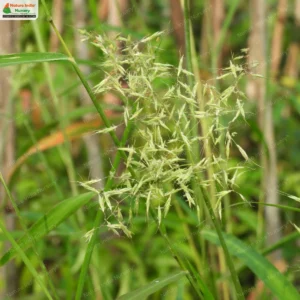
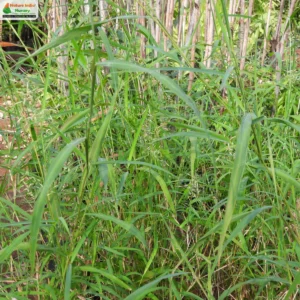
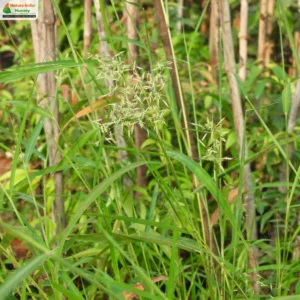

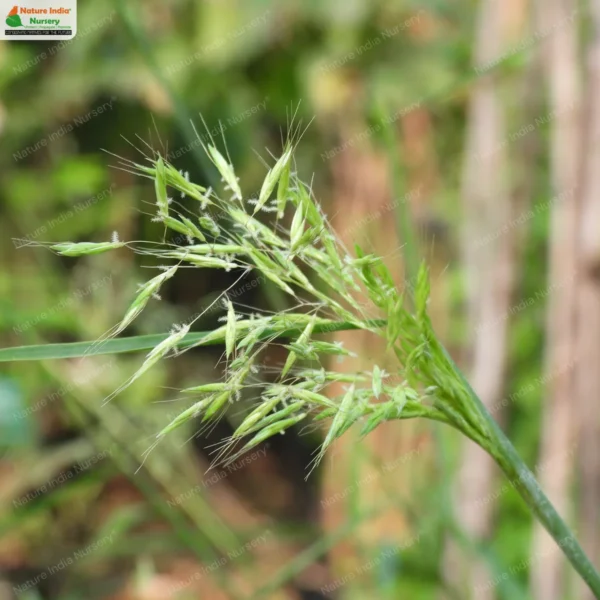


Spodiopogon rhizophorus is a delicate, tuft-forming grass belonging to the Poaceae (grass family). Native to India, it is particularly associated with the Western Ghats, where it grows along shaded forest edges, woodland paths, and roadside cuttings. Its distinctive leaves, which narrow into a slender stalk-like base, and its hairy, awned flower clusters make it an interesting species among native grasses.
The plant generally grows from about 20–70 cm tall, although larger specimens may occur under favourable conditions. Its stems are slender and branched, and the lower nodes may develop roots where they contact the ground. The leaves are lance-shaped, with a noticeable narrowed base resembling a short petiole. Small spikelets are arranged in branched flower clusters, with fine hairs and slender awns that give the inflorescence a soft, bearded appearance.
Habitat
Stalked-Leaf Beard Grass occurs in tropical and seasonally dry habitats, especially semi-evergreen forests and shaded forest margins. In India, it has been recorded in Maharashtra, Karnataka, and Kerala, including parts of the Western Ghats. It may also grow on slopes and along forest roads where suitable moisture and light conditions occur.
Planting and Care
- Light: Partial shade or filtered sunlight is suitable; it can also grow in brighter openings with adequate moisture.
- Soil: Prefers well-drained soil with some organic matter.
- Watering: Provide moderate moisture during active growth, avoiding prolonged waterlogging.
- Maintenance: Allow the grass to complete its flowering and seed-setting cycle. Retain some seed heads where natural regeneration is desired.
- Propagation: Primarily by seed; rooted lower stem nodes may also help the plant spread locally.
Additional Information
Ecological Importance: As a native forest grass, it contributes to ground-layer vegetation and local plant diversity. Its flowers and seeds form part of the resources available to small insects and other grassland or woodland organisms.
Special Feature: The narrowed, stalk-like leaf base is a useful identification characteristic. Its hairy spikelets and awned flower parts provide another distinctive feature when the plant is flowering.
Flowering Season: Botanical records from peninsular India indicate flowering and fruiting mainly from September to December, though timing can vary with location and seasonal conditions.
Conservation Note: Although it is recorded from several Indian regions, Kew’s extinction-risk prediction lists the species as potentially threatened. Protecting native forest margins and avoiding unnecessary disturbance of wild populations are sensible conservation measures.