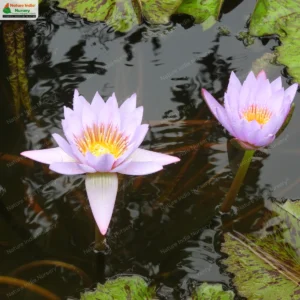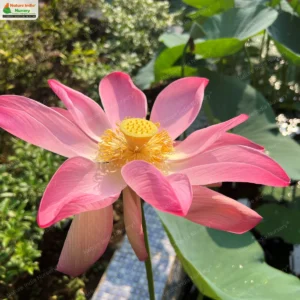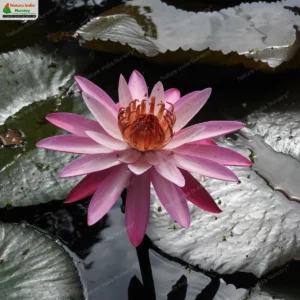
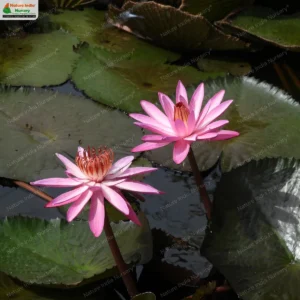
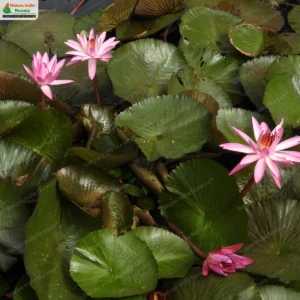
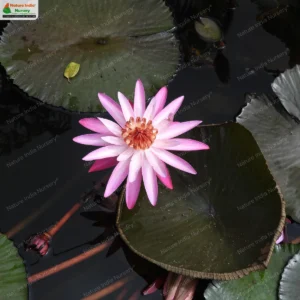

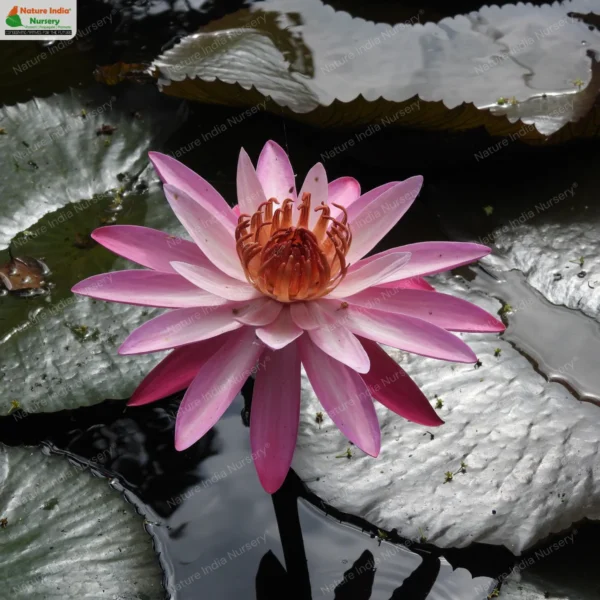


Nymphaea pubescens, commonly known as Pink Water Lily, is a perennial aquatic herb belonging to the Nymphaeaceae (water-lily) family. It is native to tropical and subtropical Asia through northeastern Australia and is commonly found in ponds and other still or slow-moving freshwater habitats.
The plant grows from a thick, creeping rhizome rooted in submerged mud. Its rounded to elliptic floating leaves are often finely hairy or pubescent, with toothed margins and basal lobes. The attractive pink flowers rise above the water surface, while white and reddish forms are also reported.
Habitat
Nymphaea pubescens is primarily associated with shallow freshwater ponds, stagnant water bodies, marshes and other wetland habitats. Its native range extends from the Indian subcontinent and Southeast Asia through southern China and the Philippines to northern Australia.
Planting and Care
Light: Full sun is ideal and encourages vigorous growth and flowering.
Soil: Heavy, fertile clay or loamy aquatic soil rich in organic matter is suitable. The rhizome should be firmly rooted in submerged soil.
Watering: Maintain a consistent water level over the planting medium. Shallow, still or gently moving water is preferable.
Maintenance: Remove old leaves and spent flowers regularly. Thin overcrowded plants periodically to prevent excessive rhizome spread and maintain healthy growth.
Additional Information
Ornamental Use: The attractive pink flowers and floating foliage make it well suited for ponds, water gardens, temple landscapes and naturalistic wetland gardens.
Ecological Importance: The flowers provide nectar and pollen for insects, while the floating leaves offer shelter and resting surfaces for small aquatic organisms.
Special Feature: The leaves are characteristically pubescent (finely hairy), an unusual feature among water lilies. The flowers rise above the water surface and may reach approximately 5–15 cm across.
Fragrance: The flowers are reported to be fragrant, and India Flora Online notes the species as a strongly fragrant, night-flowering water lily.
Traditional and Culinary Importance: The rhizomes and roots have been used as vegetables and in traditional medicine in parts of its range. Such traditional uses should not be interpreted as established clinical efficacy.
Propagation: Propagation can be carried out through rhizome division or seeds. Rhizome division is generally the simpler method for maintaining established plants.
Flowering and Fruiting: Flowering can occur for an extended period depending on climate; Indian botanical records report flowering and fruiting throughout the year, while field observations in northern India commonly record flowering during August–October.
Taxonomic Note: Nymphaea pubescens Willd. is the currently accepted name. Nymphaea lotus var. pubescens is treated as a synonym rather than a separate accepted taxon.
Conservation Status: The species is assessed as Least Concern (LC) on the IUCN Red List according to Kew’s Plants of the World Online.