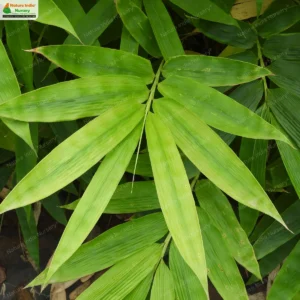
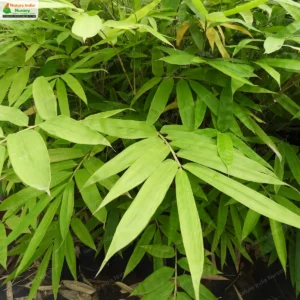
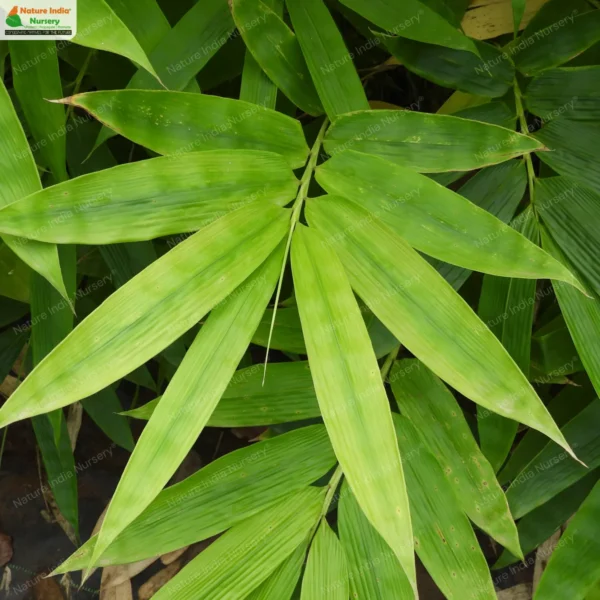

Dendrocalamus longispathus, commonly known as Long-Sheath Bamboo, is a large, clump-forming bamboo belonging to the Poaceae family. It is native from northeastern India through Bangladesh, Myanmar, Thailand, Laos, and Peninsular Malaysia, and is primarily associated with warm, wet tropical regions. The species is also known by the name Rupai in parts of northeastern India.
The plant forms dense clumps of tall, straight culms that can reach approximately 10–18 m in height, with culm diameters commonly around 4–10 cm. Young culms are glaucous green and become greyish-green with age. The long, persistent culm sheaths are a distinctive feature of the species, while branches develop mainly from the middle and upper portions of the culms.
Habitat
Dendrocalamus longispathus grows naturally in moist tropical forests, river valleys, lowland areas, and mountain slopes, particularly in the humid landscapes of northeastern India and mainland Southeast Asia. It performs well in warm climates with substantial seasonal rainfall.
Planting and Care
Light: Full sun to light partial shade. Good sunlight promotes strong culm development.
Soil: Prefers fertile, well-drained loamy or clay-loam soils with good moisture retention and organic matter.
Watering: Provide regular moisture during establishment and active growth. Mature plants benefit from consistent moisture but should not remain in stagnant water.
Maintenance: Allow adequate space for the clump to expand. Remove weak, damaged, or overcrowded culms periodically to maintain a healthy stand and encourage new growth.
Additional Information
Landscape Use: Its tall, upright culms and dense foliage make it suitable for large landscapes, bamboo groves, screening, windbreaks, and botanical collections where sufficient space is available.
Economic Importance: Dendrocalamus longispathus is an economically useful bamboo. Its culms are used for construction, basketry, mats, furniture, handicrafts, containers, pulp, and other bamboo products. It is also used for landscaping and several traditional household applications.
Edible Use: Young shoots are consumed as a food resource in parts of northeastern India after appropriate preparation.
Ecological Importance: Dense bamboo clumps provide habitat and cover for wildlife, contribute organic matter to the soil, and help stabilize soil in suitable moist environments.
Special Feature: The species is particularly recognizable by its long culm sheaths, which give rise to the common name Long-Sheath Bamboo. The culms are also notable for their considerable height and relatively thick walls.
Propagation: Propagation can be carried out through seed and vegetative methods, including suitable culm or rhizome-based planting material.
Flowering: Like many large bamboos, flowering is infrequent and may occur after a long vegetative interval. Reported flowering cycles for this species are in the range of several decades.
Growth Habit: It is a densely clumping bamboo with short-necked pachymorph rhizomes, making it different from running bamboos that spread extensively through long rhizomes.