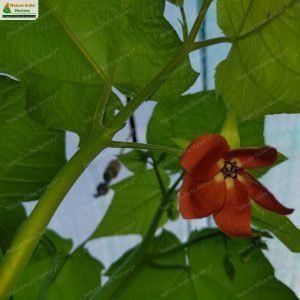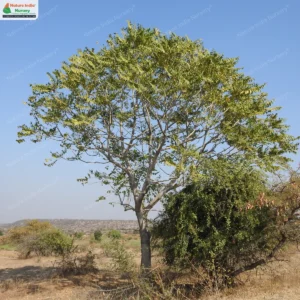
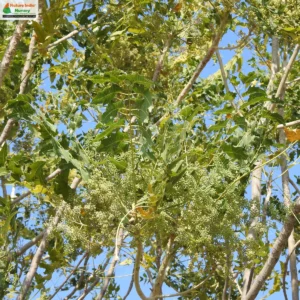
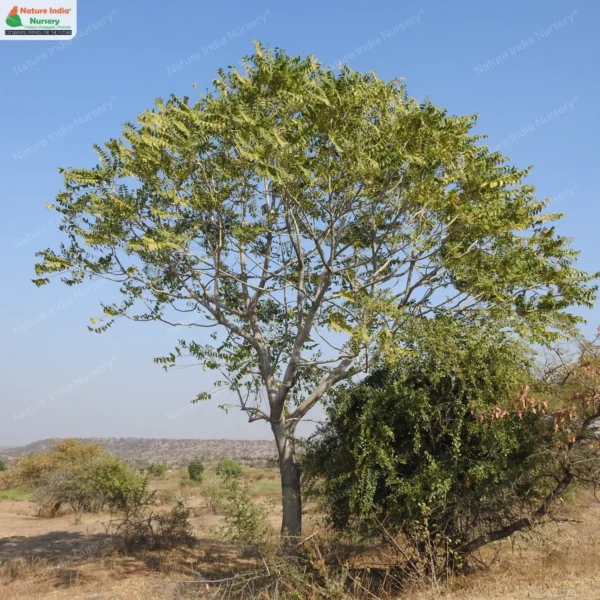

Ailanthus excelsa Roxb. is a large, fast-growing, deciduous tree belonging to the family Simaroubaceae. Native to the Indian subcontinent, it is commonly found in dry tropical and subtropical regions of India. The tree is valued for its rapid growth, adaptability to dry conditions, useful timber and suitability for avenue planting and agroforestry.
The tree can reach approximately 18–25 metres in height, with a straight trunk and a broad, spreading crown. Its bark is greyish to greyish-brown, becoming rough and fissured with age. The leaves are large, alternate and pinnately compound, generally bearing 8–14 pairs of leaflets. The leaflets are oblong to lance-shaped, with unequal bases and irregularly toothed margins.
The small, greenish-yellow flowers are borne in large, branched panicles near the ends of branches. The species is usually polygamous, with male and female flowers often occurring on separate trees. Its fruit is a flat, one-seeded, winged samara, typically copper-red when mature.
Habitat
Indian Tree of Heaven occurs naturally in tropical dry deciduous forests, scrublands and open woodland. It is commonly found in central, western and southern India, including Maharashtra, Rajasthan, Gujarat and parts of the Deccan Plateau. It grows on plains and hills up to approximately 1,000 metres and is particularly well adapted to semi-arid conditions.
Planting and Care
- Light: Requires full sunlight for healthy growth.
- Soil: Adaptable to different soil types, including sandy and lateritic soils; prefers porous, well-drained soil.
- Watering: Water regularly during the first one or two years after planting. Established trees tolerate dry periods.
- Climate: Suitable for warm tropical and subtropical climates, including semi-arid regions.
- Maintenance: Allow adequate space for its broad crown. Protect young plants from grazing and strong winds.
- Propagation: Commonly propagated by seeds; it can also regenerate through coppice growth.
Additional Information
- Timber: Its lightweight, pale-coloured wood is used for match splints, plywood, packing cases, fishing floats, toys and other light wooden articles.
- Fodder: The leaves are used as fodder, particularly for sheep and goats in some dry regions.
- Agroforestry: Due to its rapid growth and drought tolerance, it is planted along roadsides, farm boundaries and in agroforestry systems.
- Traditional uses: Bark and leaves have been used in traditional medicine. These historical uses should not be considered evidence of proven clinical effectiveness.
- Flowering and fruiting: Flowering generally occurs around February–March, while fruits commonly mature between May and July, depending on the region.
- Ecological value: Its broad canopy provides shade, while its flowers and fruits contribute to the resources available to local wildlife.