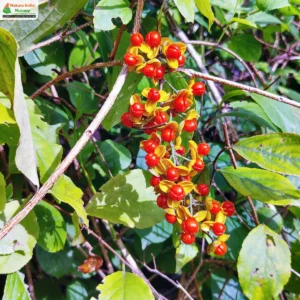
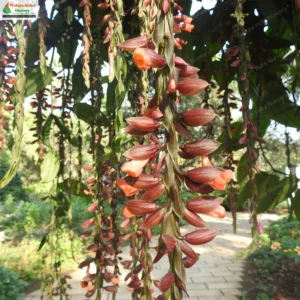


Thunbergia coccinea, commonly known as Scarlet Clock Vine, is a vigorous woody perennial climber belonging to the Acanthaceae family. It is native to the Indian Subcontinent through southern China and mainland Southeast Asia, where it occurs mainly in wet tropical and subtropical forests.
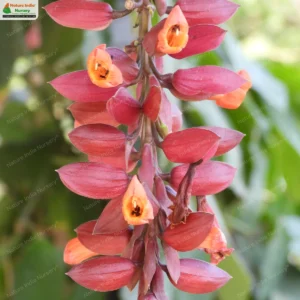
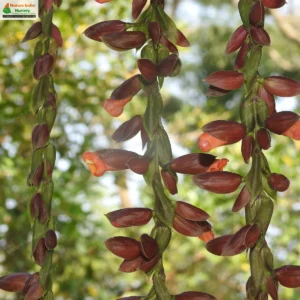
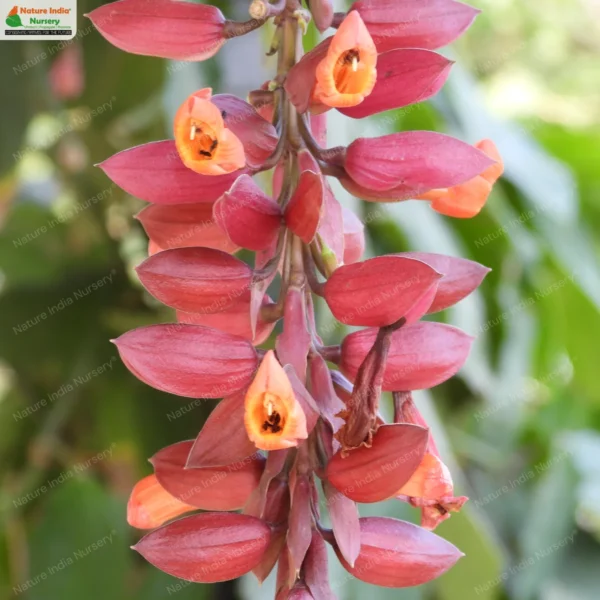
The plant develops long, twining woody stems and can climb to 5 metres or more. Its leaves are opposite, broadly ovate to lanceolate, pointed at the tip, toothed along the margins, and prominently 3–5-nerved from the base. The most striking feature is its pendent, elongated racemes bearing numerous bright scarlet-red, tubular flowers. The flowers are followed by smooth capsules containing wrinkled seeds.
Habitat
Thunbergia coccinea grows naturally in tropical and subtropical forests, particularly in humid mountain regions. It has been recorded from elevations of approximately 100–2,100 metres, extending from the Western Himalaya and Northeast India through Nepal, Myanmar, southwestern China, Laos and Thailand.
Planting and Care
Light: Bright filtered light to partial shade; it can tolerate full sun in humid climates when adequate moisture is available.
Soil: Fertile, organic-rich and well-drained soil with good moisture retention.
Watering: Water regularly during active growth, keeping the soil evenly moist without prolonged waterlogging.
Maintenance: Provide a strong trellis, pergola, fence or other support for its vigorous climbing habit. Prune after flowering to control its size and encourage fresh branching.
Additional Information
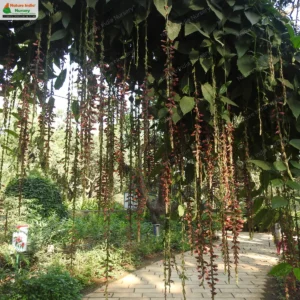
Ornamental Use: A highly attractive climber for pergolas, arches, trellises, fences and large tropical gardens, particularly where its long hanging racemes of scarlet flowers can be displayed prominently.
Ecological Importance: The conspicuous flowers provide floral resources for visiting insects and contribute to the diversity of tropical forest-edge vegetation.
Special Feature: Its most distinctive characteristic is the combination of pendulous flower racemes and vivid scarlet-red tubular flowers, which gives the plant its common name. The racemes may reach approximately 35 cm in length.
Propagation: It can be propagated by seeds and vegetative methods such as stem cuttings. Young plants should be provided with warmth, moisture and suitable climbing support.
Flowering and Fruiting: Flowering has been recorded from August to March, while fruiting generally occurs from November to May. Indian observations also record flowering and fruiting from approximately November to April, depending on locality.
Regional Names: Hindi लाल घड़ी लता (Laal Ghadi Lata) and Nepali सिंगार्ने लहरा (Singarne Lahara) are documented regional names.
Taxonomic Note: The accepted name is Thunbergia coccinea Wall. ex D.Don, belonging to the Acanthaceae family. Recorded synonyms include Thunbergia pendula and Hexacentris coccinea.