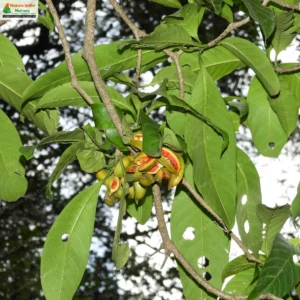
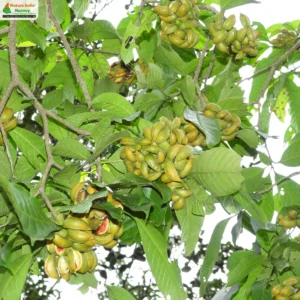
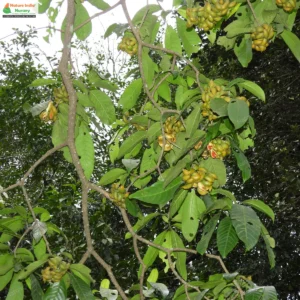


Tabernaemontana alternifolia, commonly known as Alternate-leaved Crape Jasmine or Nag Kuda, is an evergreen shrub or small tree belonging to the Apocynaceae family. Native to western and southern India, it is a characteristic plant of the Western Ghats and is valued for its delicate white flowers, glossy foliage, and importance in native forest ecosystems.
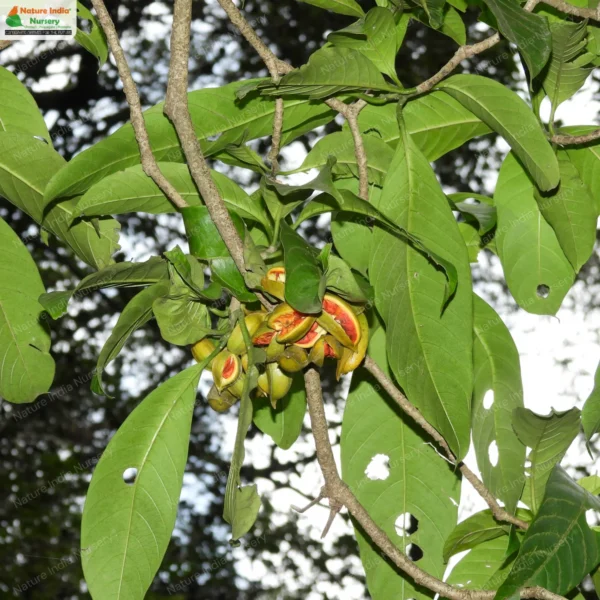
The plant generally grows about 2.5–4 m tall, developing a bushy form or small-tree habit. It has grey, rough bark and leaves that are usually oblong to oblong-lanceolate, with pointed tips and a glossy green surface. White, fragrant flowers grow in clusters at the ends of flower stalks. The flowers have a tubular corolla with five spreading lobes, followed by paired curved follicles containing seeds with a reddish or orange aril.
Habitat
Tabernaemontana alternifolia occurs in moist deciduous and semi-evergreen forests, forest edges, and relatively undisturbed woodland habitats. In the Western Ghats, it has been recorded on gentle slopes at elevations of approximately 600–1,200 m. Its native Indian distribution includes Maharashtra, Goa, Karnataka, Kerala, and Tamil Nadu.
Planting and Care
Light: Prefers partial shade or filtered sunlight, particularly in hot climates. It can tolerate brighter conditions when adequate moisture is available.
Soil: Grows best in fertile, organic-rich, well-drained soil.
Watering: Maintain moderate moisture during establishment. Water regularly during dry periods, while avoiding waterlogged soil.
Maintenance: Remove damaged or crossing branches as needed. Light pruning can help maintain a compact shrub form.
Planting Location: Suitable for native-plant gardens, shaded tropical landscapes, woodland gardens, and botanical collections.
Additional Information
Ornamental Use: Its glossy foliage and clusters of white flowers make it a suitable ornamental shrub or small tree for tropical and subtropical gardens.
Ecological Importance: The flowers are reported to be pollinated by night-flying moths, making the species valuable in forest habitats where nocturnal pollinators are active.
Traditional Significance: The plant has a history of traditional use, and phytochemical records document compounds isolated from its bark. These records do not, by themselves, establish the safety or clinical effectiveness of medicinal preparations. The plant’s latex and other parts should not be consumed or used medicinally without qualified guidance.
Special Feature: The combination of white flowers, glossy leaves, and paired curved fruits with colourful arils makes this species distinctive among native members of the genus Tabernaemontana.
Propagation: Primarily propagated through seeds. Nursery propagation should use well-drained growing media and protect young seedlings from extreme heat and drying.
Flowering and Fruiting: Regional botanical records report flowering and fruiting mainly from March to August, although the season can vary with local climate and elevation.
Conservation Significance: The species is associated with Western Ghats forest habitats, and a regional conservation document describes it as sparsely distributed. Protecting natural populations and sourcing nursery plants responsibly are therefore advisable.