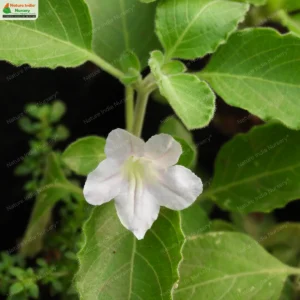
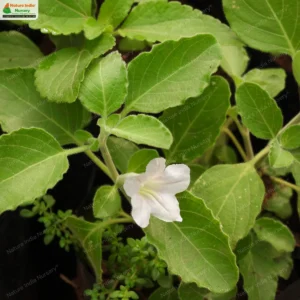
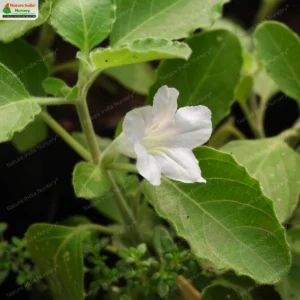
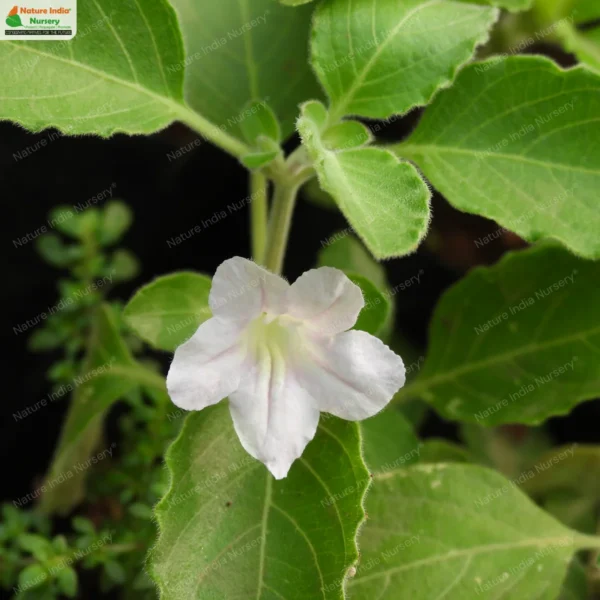


Ruellia prostrata, commonly known as Bell Weed, is a prostrate to ascending perennial herb belonging to the Acanthaceae family. It is native across tropical and subtropical regions extending from Africa and the Arabian Peninsula through the Indian Subcontinent to parts of Southeast Asia and the Pacific. It is primarily associated with seasonally dry tropical habitats.
The plant usually forms spreading or ascending stems, often rooting at the nodes, and generally grows around 25–50 cm tall, although taller scrambling forms can occur. Its leaves are simple, ovate to broadly lanceolate or elliptic, with hairy surfaces and prominent veins. Violet-blue to occasionally nearly white, bell-shaped flowers occur singly or in small clusters in the leaf axils. The flowers are followed by club-shaped, hairy capsules containing several seeds.
Habitat
Ruellia prostrata occurs in grasslands, scrub, woodland, degraded forests, forest edges and open plains, and can also occur in shaded places and along hedges. In India it has been recorded from several states, including Maharashtra, Karnataka, Kerala and Andhra Pradesh.
Planting and Care
Light: Full sun to partial shade; bright light promotes compact growth and flowering.
Soil: Well-drained loamy or sandy soil with moderate organic matter. It can tolerate relatively poor soils once established.
Watering: Moderate watering during establishment. Once established, allow the soil to dry slightly between watering while avoiding prolonged drought.
Maintenance: A relatively low-maintenance native herb. Remove dry or sprawling stems when necessary to maintain a tidy form and encourage fresh growth.
Additional Information
Ornamental Use: Its spreading habit and attractive violet-blue bell-shaped flowers make it suitable for native gardens, groundcover plantings, borders, rock gardens and naturalistic landscapes.
Ecological Importance: The flowers provide nectar and other floral resources for insects, while the low, spreading growth contributes to ground-level vegetation in open and disturbed habitats.
Special Feature: The species is particularly recognizable for its prostrate habit, axillary bell-shaped flowers and hairy club-shaped seed capsules. Some plants develop stems that root at the nodes, allowing them to spread across the ground.
Propagation: Primarily propagated by seeds. Stem cuttings may also be suitable for vegetative multiplication in cultivation.
Flowering and Fruiting: Flowering and fruiting have been recorded over an extended period, with India Flora Online reporting June–February; regional observations can vary with climate and locality.
Regional Names: Hindi धामिन (Dhamin) and Marathi काळी धावणी (Kali Dhawani) are documented names. Marathi sources also record भुई रुवेल (Bhui Ruwel).
Taxonomic Note: Ruellia prostrata Poir. is the currently accepted name. Dipteracanthus prostratus is a recorded synonym, and older botanical literature may use this name.