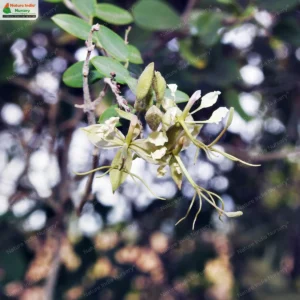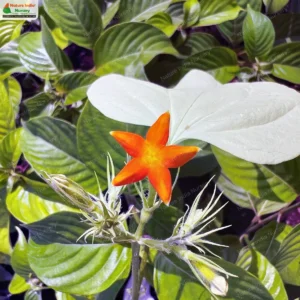
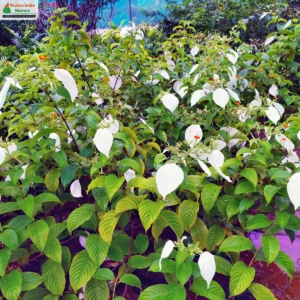
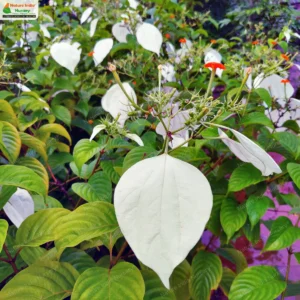
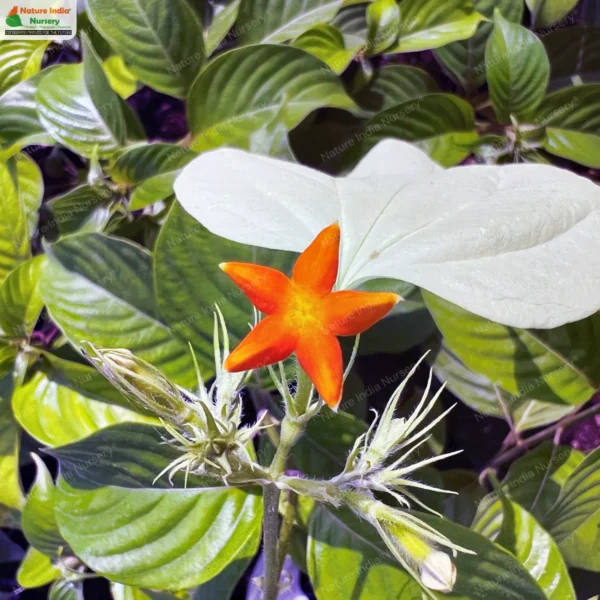


Mussaenda frondosa, commonly known as Wild Mussaenda or Dhobi Tree, is a species of flowering shrub belonging to the Rubiaceae family. Native to South and Southeast Asia, this plant is admired for its attractive yellow flowers and distinctive enlarged white sepal that resembles a flower petal, making it a popular ornamental and ecologically valuable species.
The species is a deciduous to semi-evergreen shrub that can grow up to 2–5 meters in height. It features opposite, ovate leaves with a slightly rough texture and produces clusters of small, bright yellow tubular flowers accompanied by a single large, white leaf-like sepal that enhances its visual appeal.
Habitat
Mussaenda frondosa thrives in tropical and subtropical climates. It is commonly found in forests, woodland edges, scrublands, and hilly regions, growing well in both open sunny areas and partial shade
Planting and Care
-
Light: Prefers full sun to partial shade. Adequate sunlight encourages healthy growth and abundant flowering.
-
Soil: Grows best in well-drained, fertile soil rich in organic matter but can tolerate a variety of soil types.
-
Watering: Requires moderate watering. Keep the soil evenly moist during the growing season while avoiding waterlogging. Once established, it shows moderate drought tolerance.
-
Maintenance: Prune after flowering to maintain shape and encourage new growth. The plant can be propagated through seeds or semi-hardwood stem cuttings.
Additional Information
-
Ornamental Use: Mussaenda frondosa is widely grown as an ornamental shrub due to its attractive white bracts and bright yellow flowers, making it suitable for gardens, parks, and landscape borders.
-
Ecological Importance: The flowers attract butterflies, bees, and other pollinators, contributing to local biodiversity and supporting healthy ecosystems.
-
Traditional Uses: Various parts of the plant have been used in traditional medicine in some regions for their potential medicinal properties, although these uses are based on traditional practices and should be supported by scientific guidance before medicinal use.