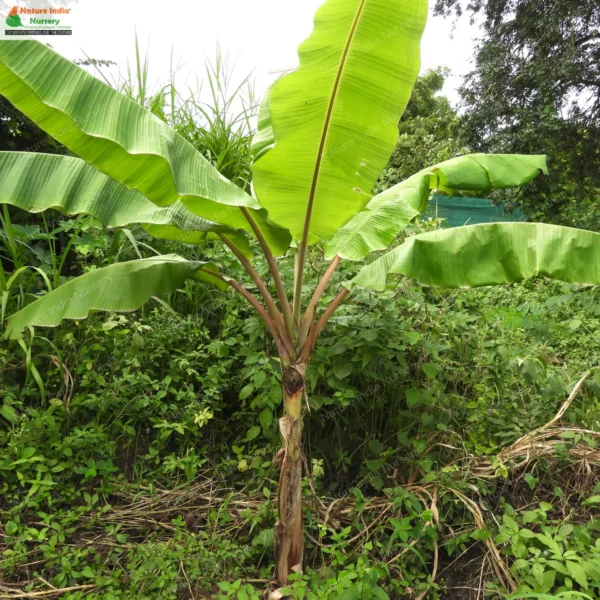
Musa acuminata, commonly known as Wild Banana, is a large perennial herb belonging to the Musaceae (banana) family. It is native to tropical and subtropical Asia and is one of the principal wild ancestors of cultivated bananas. The species is particularly important in the evolutionary history of edible bananas, many of which were derived from M. acuminata through domestication and selection.
The plant forms a clump of tall pseudostems, which are made from tightly overlapping leaf bases rather than a true woody trunk. Depending on the subspecies and growing conditions, the pseudostem may reach several metres in height. The large leaves are arranged spirally and can extend to several metres in length. The pendulous inflorescence bears separate female and male flowers, followed by elongated fruits containing numerous hard seeds in wild plants.
Habitat
Musа acuminata is primarily associated with wet tropical environments, including tropical forest margins, shaded ravines, moist slopes, marshy areas and other humid habitats. Its native range extends across India, Bangladesh, Sri Lanka, southern China and much of mainland and island Southeast Asia.
Planting and Care
Light: Partial shade to full sun. Young plants benefit from protection from intense afternoon sunlight, while established plants grow well with ample light.
Soil: Deep, fertile, organic-rich and well-drained soil with good moisture-holding capacity.
Watering: Provide regular and abundant moisture during active growth. The soil should remain moist but should not remain permanently waterlogged.
Maintenance: Remove old or damaged leaves and unwanted suckers as required. Provide adequate space because the plant develops a large clump and extensive foliage.
Additional Information
Ornamental Use: The large tropical foliage and distinctive banana form make Musa acuminata an attractive choice for tropical gardens, forest gardens, water-side landscapes and naturalistic planting schemes.
Ecological Importance: Wild bananas form part of tropical forest-edge ecosystems and provide food and shelter resources for wildlife. Their large leaves also contribute substantially to the structure of humid tropical vegetation.
Food and Genetic Importance: Musa acuminata is one of the major wild progenitors of cultivated dessert bananas. Unlike most cultivated banana clones, wild plants produce fruits containing numerous seeds.
Special Feature: The species is especially significant as a wild ancestor of modern edible bananas. Natural variation within M. acuminata has contributed to the diversity of cultivated banana varieties.
Propagation: Wild plants can be propagated from seeds, while vegetative propagation through suckers or rhizomatous portions is commonly used for banana cultivation.
Flowering and Fruiting: The plant produces a large, often pendulous inflorescence. Female flowers occur toward the base of the inflorescence and develop into fruits, while male flowers occur toward the distal portion. Wild fruits are generally seed-filled, unlike the seedless fruits of most cultivated banana clones.
Taxonomic Note: Musa acuminata Colla is the currently accepted species name. Kew recognizes several accepted subspecies and varieties within the species, reflecting its considerable geographical and morphological diversity.