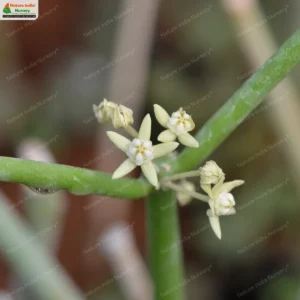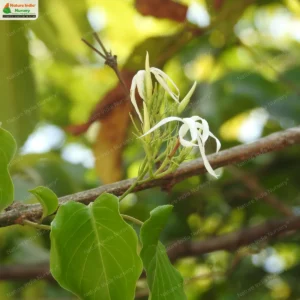
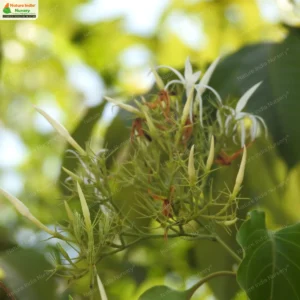
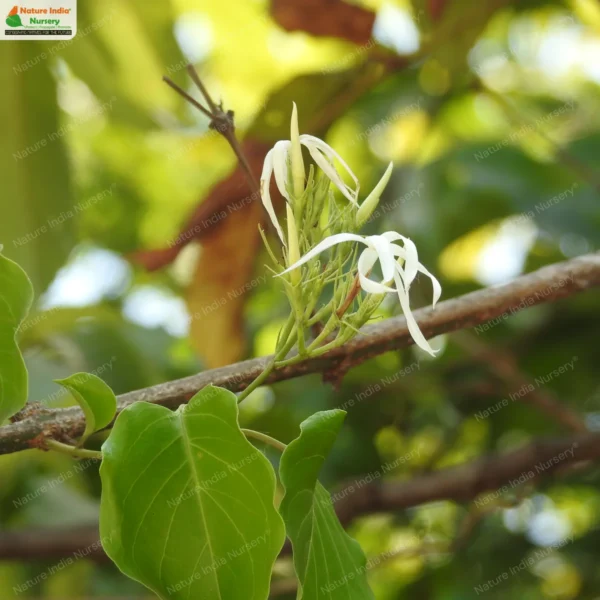

Jasminum malabaricum, commonly known as Malabar Jasmine, is a woody climbing or scrambling shrub belonging to the Oleaceae (olive and jasmine) family. It is a species associated with the Western Ghats and peninsular India, particularly in moist forest habitats. The plant is valued for its attractive foliage and fragrant white flowers.
The plant develops slender, branching stems with opposite, simple, broadly ovate to elliptic leaves. Its white, fragrant, tubular flowers are produced in clusters, with the characteristic narrow floral tubes typical of many jasmine species. The flowers may be followed by small dark fruits.
Habitat
Jasminum malabaricum is primarily associated with the moist forests and hill regions of peninsular India, especially the Western Ghats. It commonly occurs along forest margins, woodland, slopes and other partially shaded habitats with good atmospheric humidity.
Planting and Care
Light: Partial shade to bright filtered light. It can tolerate some morning or gentle sunlight but performs best when protected from intense afternoon heat.
Soil: Rich, organic, well-drained soil with good moisture-retention capacity. A humus-rich forest-type soil is ideal.
Watering: Keep the soil moderately moist during active growth, particularly during warm and dry periods. Avoid stagnant water around the roots.
Maintenance: Provide a support or trellis if grown as a climber. Light pruning after flowering helps maintain shape and encourages new branching.
Additional Information
Ornamental Use: The combination of fragrant white flowers and attractive green foliage makes it suitable for native gardens, fragrance gardens, trellises, shaded courtyards and naturalistic landscapes.
Ecological Importance: As a native jasmine of peninsular India’s forest ecosystems, it contributes to local plant diversity and provides floral resources for insects and other flower visitors.
Fragrance: The flowers are pleasantly fragrant, making the species particularly attractive for gardens intended to include native scented plants.
Cultural Significance: The Marathi names कुसर and रान मोगरा reflect its recognition as a wild or forest-associated jasmine. The name रान मोगरा literally refers to a wild jasmine and distinguishes it from commonly cultivated jasmine species.
Propagation: Propagation can be carried out through seeds or stem cuttings. Semi-mature cuttings taken during the active growing season can be rooted under warm, humid conditions.
Flowering and Fruiting: Flowering generally occurs during the warmer and monsoon periods, with timing varying according to elevation and local climate. Fruits develop after successful pollination and mature into dark-coloured berries.
Special Feature: Its association with the Western Ghats and moist forest habitats, together with fragrant white flowers, makes Jasminum malabaricum a useful species for native and biodiversity-oriented gardens.