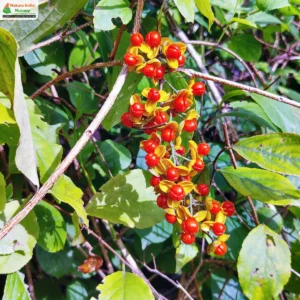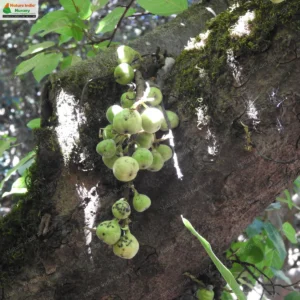
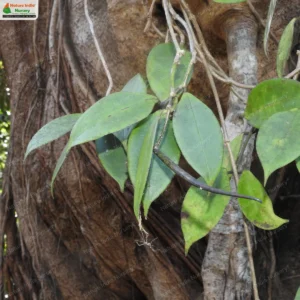
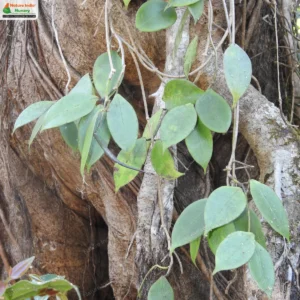


Hoya alexicaca, commonly known as Konkan Wax Flower, is a perennial climbing epiphyte or lithophyte belonging to the Apocynaceae family. It is native to eastern and southern India through Myanmar and is typically found growing on trees or rocks in seasonally dry tropical habitats.
The plant is a fleshy, twining climber with slender, often pendulous branches. Its leaves are opposite, thick, glossy, and elliptic to ovate-lanceolate, giving the plant a characteristic waxy appearance. The fragrant flowers are produced in compact umbels and are white with a distinctive star- or pinwheel-like form.
Habitat
Hoya alexicaca is primarily an epiphytic climber of shaded, moist forests, where it grows on trees and occasionally on rocks. Indian botanical records document it from the Eastern Ghats and other parts of peninsular India, while Kew records its wider native range from eastern and southern India to Myanmar.
Planting and Care
Light: Bright filtered light or partial shade is ideal. Protect from harsh afternoon sunlight.
Soil: Use a very well-drained, porous growing medium rich in organic matter. A loose epiphytic or orchid-type mix is suitable for cultivated plants.
Watering: Water moderately during active growth, allowing the growing medium to dry partially between waterings. Avoid prolonged waterlogging.
Maintenance: Provide a trellis, branch, or other support for the twining stems. Avoid excessive pruning, particularly of mature flowering spurs, as these may produce flowers repeatedly.
Additional Information
Ornamental Use: The thick glossy foliage and attractive, fragrant, wax-like flowers make this species suitable for native plant gardens, shaded courtyards, hanging containers, trellises, and botanical collections.
Ecological Importance: As an epiphytic forest climber, it contributes to the diversity of vegetation growing on trees and provides floral resources for visiting insects.
Special Feature: The flowers have a distinctive pinwheel-like form with a fleshy, star-shaped corona. The thick leaves and fleshy stems are adaptations associated with its epiphytic climbing habit.
Traditional Importance: The species has been recorded in Indian traditional plant-use literature, with leaves, roots, latex, and flowers mentioned in ethnobotanical sources. Traditional uses should not be interpreted as established clinical treatments.
Propagation: Best propagated through stem cuttings with suitable nodes. Cuttings should be rooted in a porous, well-drained medium under warm and humid conditions.
Flowering: Indian botanical records report flowering mainly from May to January, with some regional sources specifically recording May–August. Flowering therefore varies with local climate and habitat.
Fruiting: The plant produces elongated follicles containing numerous seeds with silky hairs that aid wind dispersal.
Taxonomic Note: Hoya pendula and Hoya iconum are currently treated as synonyms of Hoya alexicaca by Kew.