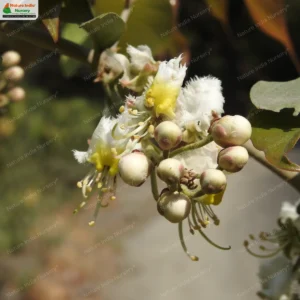
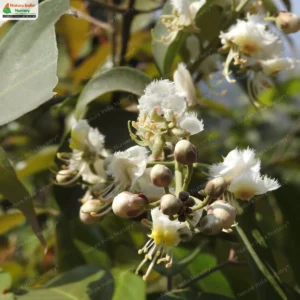


Hiptage benghalensis, commonly known as Helicopter Flower or Madhavi Lata, is a large, woody, evergreen climber or scrambling shrub belonging to the Malpighiaceae family. It is native to tropical and subtropical regions of the Indian subcontinent and Southeast Asia. The plant is particularly valued for its attractive, fragrant flowers and distinctive winged fruits.
The plant develops long, woody, twining branches that can climb into surrounding vegetation or spread as a large shrub. Its leaves are opposite, simple, and glossy, ranging from elliptic to ovate in shape. The highly fragrant flowers occur in terminal or axillary clusters and are usually white to pink, often with yellow or reddish markings. The fruits are distinctive three-winged samaras, which rotate as they fall and give the plant its common name, Helicopter Flower.
Habitat
Hiptage benghalensis occurs naturally in tropical forests, forest margins, woodland, scrub, riverbanks, and rocky slopes. It grows particularly well in warm regions with seasonal or year-round moisture and can tolerate both open and partially shaded conditions.
Planting and Care
Light: Full sun to partial shade. Good sunlight encourages abundant flowering, while some shade is tolerated.
Soil: Prefers fertile, well-drained loamy soil enriched with organic matter. It can tolerate a range of soils provided drainage is adequate.
Watering: Provide regular watering during establishment and active growth. Once established, it can tolerate moderately dry periods.
Maintenance: Provide a strong trellis, pergola, fence, or other support. Regular pruning is useful for controlling its vigorous growth and maintaining a manageable shape.
Additional Information
Ornamental Use: The plant is highly valued as an ornamental climber for pergolas, arches, fences, trellises, and large garden structures. Its fragrant flowers and dense evergreen foliage provide both visual and sensory appeal.
Fragrance: The flowers are strongly and pleasantly fragrant, particularly noticeable during the flowering season.
Ecological Importance: Its flowers provide nectar and floral resources for insects and other pollinators. The distinctive winged fruits facilitate wind-assisted dispersal.
Special Feature: The fruit has three prominent wings. As it falls, the winged structure can spin or glide through the air, resembling the rotating blades of a helicopter.
Traditional and Cultural Importance: Hiptage benghalensis is associated with the traditional Indian name माधवी लता (Madhavi Lata) and has a long history in Indian botanical and cultural traditions. Various parts of the plant have also been recorded in traditional medicinal practices; such uses should not be interpreted as established clinical treatments.
Propagation: Propagation can be carried out through seeds or stem cuttings. Fresh seeds generally provide better germination, while suitable semi-mature cuttings can be rooted under warm and humid conditions.
Flowering and Fruiting: Flowering commonly occurs during the warmer months and monsoon period, depending on the local climate. The characteristic three-winged fruits develop after flowering and mature during the following months.
Growth Habit: It is a vigorous woody climber and can become a substantial plant, so adequate space and a strong supporting structure should be provided in cultivation.