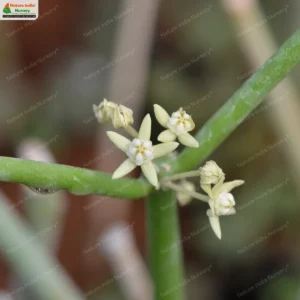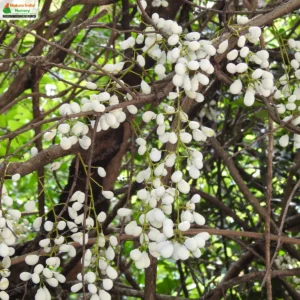
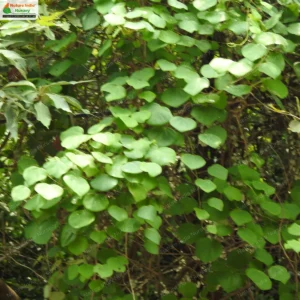
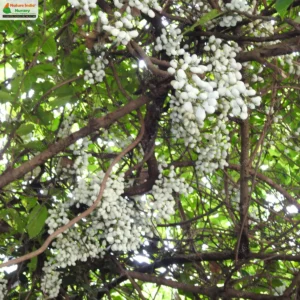
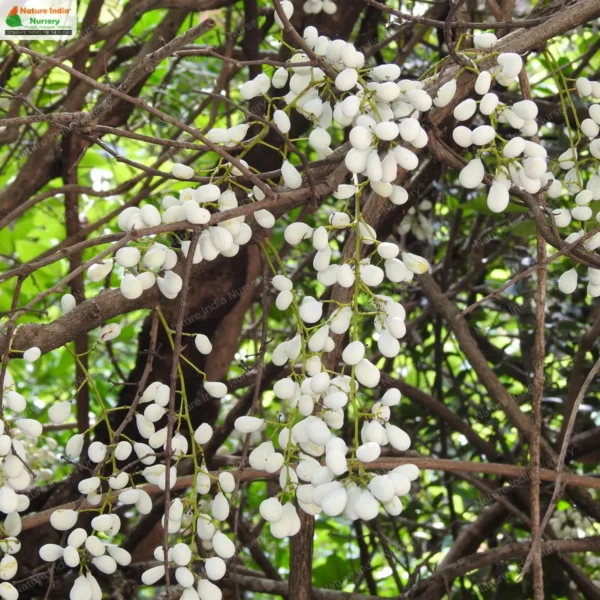


Diploclisia glaucescens, commonly known as Glaucous Diploclisia, is a woody climbing plant belonging to the Menispermaceae family. It is native to tropical Asia, including India, Sri Lanka, Myanmar, Thailand, southern China, and parts of Southeast Asia. The species is a characteristic climber of tropical forests, particularly sheltered valleys, ravines, and forest margins.
The plant is an extensive woody liana with brownish bark and simple, broadly ovate to suborbicular leaves. The leaves are often heart-shaped at the base and may have a distinctly glaucous or bluish-green appearance beneath. Small yellow flowers are borne in branched panicles, often arising from older woody portions of the plant. The fruits are fleshy drupes, becoming reddish as they mature.
Habitat
Diploclisia glaucescens occurs in tropical evergreen, semi-evergreen, and moist deciduous forests. It is particularly associated with sheltered sholas, ravines, forest edges, and moist woodland habitats, commonly occurring at elevations of approximately 600–900 m, although it can occur at higher elevations as well.
Planting and Care
Light: Partial shade to filtered sunlight is ideal. It can tolerate brighter conditions when adequate moisture is available.
Soil: Prefers fertile, humus-rich, well-drained soil with good moisture retention.
Watering: Provide regular moisture during active growth. Avoid prolonged waterlogging, particularly in cultivated conditions.
Maintenance: Provide a strong trellis, tree, or other support for the climbing stems. Periodic pruning can be used to control vigorous growth and maintain the desired form.
Additional Information
Ornamental Use: The glossy foliage, unusual glaucous leaf undersides, yellow flowers, and climbing habit make it suitable for native plant gardens, large trellises, forest gardens, and botanical collections.
Ecological Importance: As a native forest liana, it contributes to the structural complexity of tropical vegetation and provides additional cover within forest habitats. Its flowers also attract insects; historical observations from the Western Ghats have recorded bees visiting the flowering plant.
Traditional Importance: Diploclisia glaucescens has been recorded in traditional medicinal plant databases, including use in the Siddha system. Its medicinal use is traditional and should not be interpreted as established clinical efficacy.
Traditional Use of Leaves: Historical botanical records from Maharashtra note that the leaves have been used locally as cigarette wrappers.
Special Feature: The species is notable for its glaucous foliage and extensive woody climbing habit. Its yellow flowers and pendulous, glaucous-green fruits add further seasonal interest.
Propagation: Propagation may be carried out from seeds or suitable vegetative material. Seeds should be sown in a well-drained, moisture-retentive growing medium.
Flowering and Fruiting: Flowering and fruiting have been recorded mainly from February to August in Indian botanical records, with local variation. Records from the Khandala region report flowering from March to June and fruiting from April to September.
Conservation: India Flora Online currently lists the species as Not Evaluated (NE) in its database.