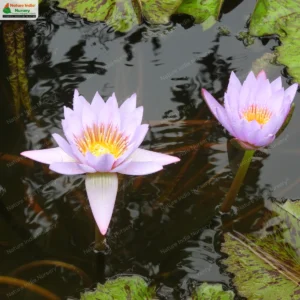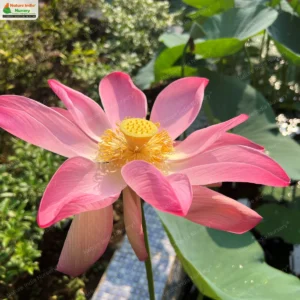
Nymphaea pubescens Willd. belongs to the family Nymphaeaceae, the water-lily family. It is a perennial aquatic herb native to tropical and subtropical Asia, extending to northern Australia. It grows from a creeping or tuberous rhizome rooted in the mud beneath still or slowly moving freshwater. Its long-stalked, floating leaves are broadly ovate, rounded or heart-shaped, with toothed or wavy margins. The upper leaf surface is generally green and often smooth, while the lower surface is characteristically covered with soft, velvety hairs, giving the species its name. The large, slightly fragrant flowers rise above or float on the water surface and are commonly white, although pinkish or reddish forms are also reported. Numerous petals surround yellow stamens. The fruit is a rounded, fleshy berry that develops underwater and contains many small seeds.
Habitat
The species commonly inhabits freshwater ponds, lakes, pools, marshes, ditches and other stagnant or slow-moving water bodies. It is widely distributed across the Indian plains and occurs throughout tropical and subtropical Asia. It generally grows in shallow water with a muddy substrate and adequate sunlight.
Planting and Care
- Light: Requires full sunlight for healthy leaf growth and flowering.
- Soil: Grows best in heavy, fertile, clay-rich aquatic soil that retains nutrients and supports the rhizome.
- Watering: Cultivate in a pond or water container with a stable water level. Keep the rhizome submerged and the leaves floating on the surface.
- Climate: Suited to warm tropical and subtropical climates.
- Maintenance: Remove decaying leaves and spent flowers periodically. Control excessive growth if the plant spreads beyond its intended area.
- Propagation: Propagated through seeds and division of rhizomes. Rhizome division is a practical method for maintaining desirable plants.
Additional Information
- Edible parts: The rhizomes and flower stalks are used as vegetables in several parts of South Asia. The seeds may also be roasted and eaten.
- Traditional importance: Different plant parts have been used in traditional systems of medicine. Such uses are historical and should not be interpreted as established clinical treatments.
- Ornamental value: Its large floating leaves and attractive flowers make it suitable for natural ponds, water gardens and aquatic landscapes.
- Ecological value: The leaves and flowers provide shelter and habitat for aquatic organisms and visiting insects.
- Flowering and fruiting: Flowers and fruits may occur throughout the year in suitable tropical conditions, with flowering often particularly abundant during the monsoon and post-monsoon months.
- Identification: The soft, velvety hairs on the lower leaf surface are a useful distinguishing feature, helping separate this species from water lilies with glabrous leaves.