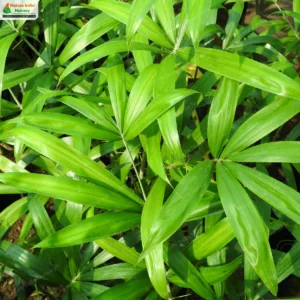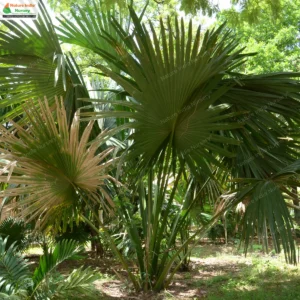
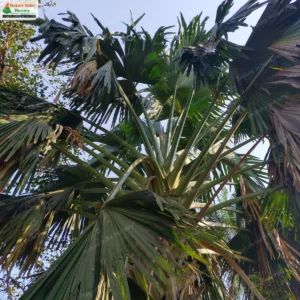
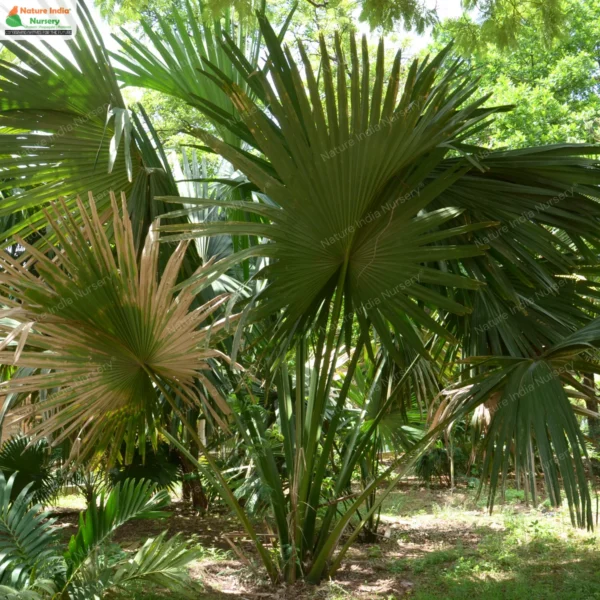

Corypha umbraculifera is a magnificent, large, solitary palm belonging to the Arecaceae (palm family). Native to western and southern India and Sri Lanka, it is renowned for its enormous fan-shaped leaves and spectacular flowering crown. The palm is valued for its traditional uses, especially in thatching, handicrafts, and the preparation of manuscripts from palm leaves.
The Talipot Palm can grow to approximately 20–25 metres tall, with a single, stout, unbranched trunk marked by prominent leaf scars. Its enormous, fan-shaped leaves may reach several metres across and are supported by long, sturdy leaf stalks with small teeth along their margins. At maturity, the palm produces a gigantic, branched terminal flower cluster bearing numerous small, cream-coloured flowers.
Habitat
Talipot Palm occurs naturally in tropical, humid regions, particularly moist lowland forests and coastal areas. In India, it is recorded in parts of Maharashtra, Karnataka, and Kerala. It grows best in warm climates with good rainfall and sufficient soil moisture, and is also cultivated in gardens, parks, and botanical collections.
Planting and Care
- Light: Full sun is best for healthy growth.
- Soil: Prefers deep, fertile, well-drained soil enriched with organic matter.
- Watering: Water regularly during establishment and dry spells. Mature palms tolerate some seasonal dryness, but prolonged drought can affect growth.
- Maintenance: Provide ample space for the broad leaf crown and eventual flower cluster. Remove dead leaves carefully and avoid damaging the growing tip.
- Propagation: Usually propagated by seeds. Germination may be slow, so fresh, viable seeds and patience are important.
Additional Information
Traditional Uses: The large leaves have been used for making umbrellas, thatching, fans, mats, baskets, and other household articles. Dried and prepared leaves have historically served as writing material for manuscripts. Starch can also be extracted from the trunk under traditional practices.
Ecological Importance: Its flowers provide resources for visiting insects and other flower-associated organisms. The large crown and trunk also contribute to the structure and visual diversity of tropical landscapes.
Special Feature — Monocarpic Flowering: The Talipot Palm is monocarpic, meaning that it flowers only once in its lifetime and dies after fruiting. This spectacular event usually occurs after many years of growth, often several decades, when a huge flowering structure rises above the crown.
Ornamental Value: With its immense fan-shaped foliage and dramatic mature form, it makes a striking specimen palm for spacious tropical gardens, parks, and botanical gardens.