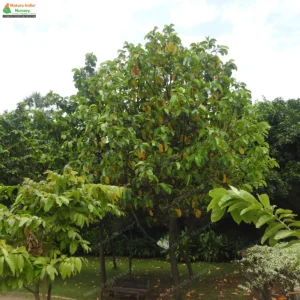
Cullenia exarillata is a large evergreen tree belonging to the family Malvaceae. Endemic to the southern Western Ghats of India, it is a characteristic canopy species of tropical wet evergreen forests. It can grow up to 40 metres tall and is recognised by its straight, buttressed trunk, large leathery leaves and distinctive spiny fruits.
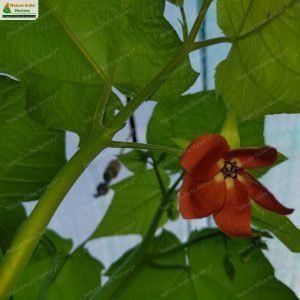
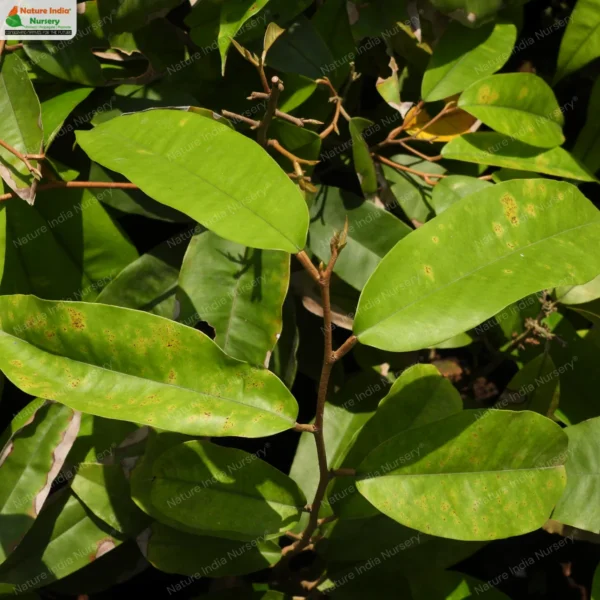
The leaves are simple, alternate and elliptic to oblong-lanceolate, with a glossy green upper surface and a hairy underside. Its unusual flowers grow in dense clusters directly on older branches and the trunk. They are tubular and generally brownish-yellow to cream or pinkish-brown. The large, nearly spherical fruits are covered with sharp spines and split open when mature to release the seeds.
Habitat
Cullenia exarillata occurs naturally in the tropical wet evergreen forests of the southern Western Ghats, particularly in Kerala, Karnataka and Tamil Nadu. It is commonly found in mature forests at mid-elevations, generally around 500–1,400 metres above sea level.
Planting and Care
Light: Prefers filtered sunlight when young and can grow into the forest canopy as it matures.
Soil: Grows best in deep, fertile, well-drained soil rich in organic matter.
Watering: Requires consistently moist soil, especially during its early growth stages.
Climate: Suited to warm, humid tropical climates with abundant rainfall.
Maintenance: Requires considerable space to develop its large canopy and root system. It is more suitable for forest restoration and large landscapes than small gardens.
Propagation: Generally propagated through seeds. Fresh seeds are preferable, as they are sensitive to drying and may lose viability during storage.
Additional Information
- Ecological Importance: The flowers and seeds provide food for forest wildlife. The tree is particularly important to the endangered lion-tailed macaque, which feeds on its flowers and other plant resources.
- Forest Significance: It is an important canopy tree in the mid-elevation evergreen forests of the southern Western Ghats.
- Flowering and Fruiting: Flowering and fruiting periods vary with location and local climatic conditions.
- Conservation: As a Western Ghats endemic associated with tropical rainforest habitats, its long-term survival depends on the protection of mature evergreen forests and their ecological connectivity.