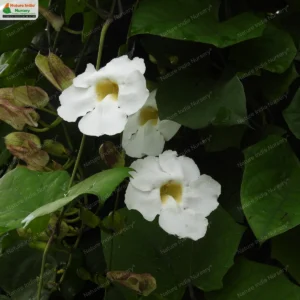
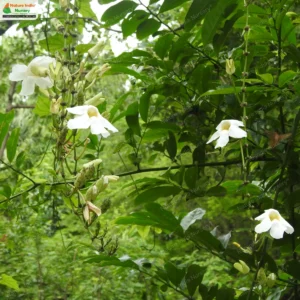
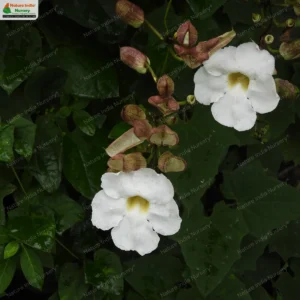

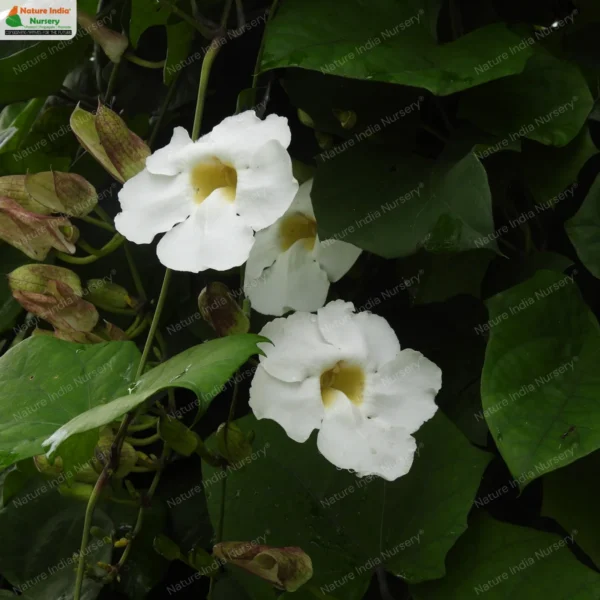


Thunbergia grandiflora, commonly known as Bengal Clock Vine, is a vigorous evergreen or semi-evergreen perennial climber belonging to the Acanthaceae family. It is native to the Indian Subcontinent and mainland Southeast Asia and is widely cultivated as an ornamental climber in tropical and subtropical regions.
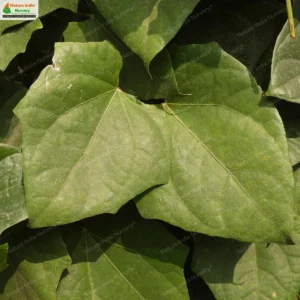
The plant develops long, twining or scrambling stems that can climb extensively over trees, fences and supporting structures. Its leaves are opposite, broadly ovate to heart-shaped, pointed at the tip and toothed along the margins. Large, showy, trumpet-shaped flowers are borne in hanging clusters. The typical flowers are lavender-blue to violet with a pale or yellowish throat, while cultivated white-flowered forms are also grown.
Habitat
Thunbergia grandiflora naturally occurs in moist tropical and subtropical forests, forest margins, thickets and riverine vegetation. It performs particularly well in warm, humid environments with abundant moisture and can grow vigorously where suitable support is available.
Planting and Care
Light: Full sun to partial shade. Bright filtered light is ideal in hot climates.
Soil: Fertile, organic-rich, well-drained soil with good moisture retention.
Watering: Regular watering during active growth. Keep the soil moderately moist but avoid prolonged waterlogging.
Maintenance: Provide a strong trellis, pergola, fence or arch. Regular pruning is important because the plant is a vigorous climber and can rapidly cover surrounding vegetation.
Additional Information
Ornamental Use: An excellent flowering climber for pergolas, arches, trellises, fences, walls and large tropical gardens. The large trumpet-shaped flowers provide a strong visual display.
Ecological Importance: The conspicuous flowers provide nectar and pollen resources for visiting insects and contribute to the floral diversity of tropical garden and forest-edge habitats.
Special Feature: The species is notable for its large trumpet-shaped flowers, which are usually blue or violet but also occur in cultivated white-flowered forms. Its vigorous growth makes it particularly effective for rapidly covering structures.
Propagation: Commonly propagated by stem cuttings and seeds. Stem cuttings generally establish readily under warm, humid conditions.
Flowering and Fruiting: Flowering can occur for extended periods in warm tropical climates, particularly during the rainy and warmer seasons. Fruiting follows flowering with the development of characteristic capsules.
Regional Name: नील लता (Neel Lata) is a regional name associated with the plant.
Taxonomic Note: Thunbergia grandiflora (Roxb. ex Rottler) Roxb. is the accepted botanical name and belongs to the Acanthaceae family. It is closely related to other ornamental Thunbergia climbers but is distinguished by its large flowers and heart-shaped foliage.