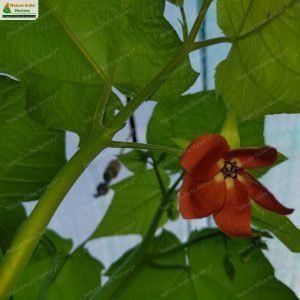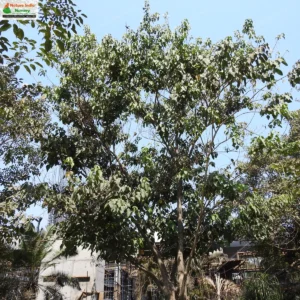
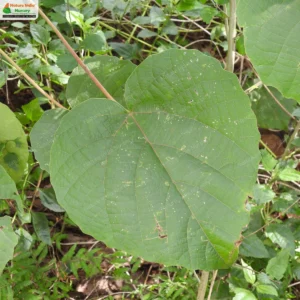
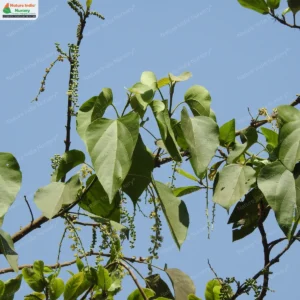
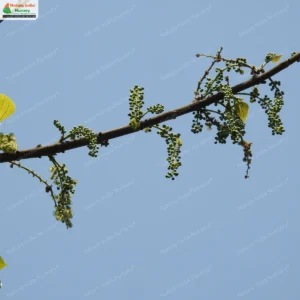
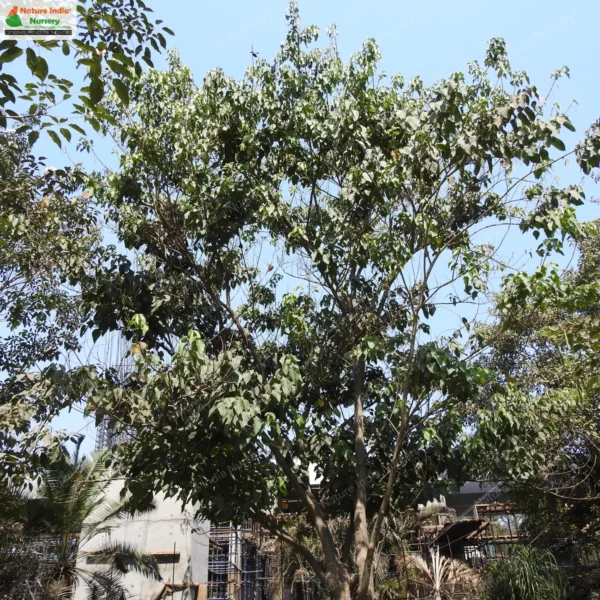


Mallotus nudiflorus (L.) Kulju & Welzen is a medium-sized deciduous tree belonging to the family Euphorbiaceae, commonly known as the spurge family. It is widely distributed across the Indian subcontinent, the Himalayan region, southern China, Southeast Asia and parts of Malesia. The species is commonly associated with moist deciduous forests, riverbanks and other humid tropical habitats. It can grow to approximately 20 m in height, with a straight trunk and a spreading crown. The bark is generally smooth and greyish-brown, with a pale yellowish inner layer and pinkish tones beneath. Young shoots are often covered with soft, dense hairs. The leaves are simple and broadly ovate to heart-shaped, with a pointed tip and a characteristic arrangement along the branches. Male and female flowers are borne separately on the same tree, usually in clusters or elongated inflorescences. The flowers are small and pale green. The fruit is a rounded, hairy capsule that becomes smoother as it matures and splits open to release dark seeds.
Habitat
Mallotus nudiflorus grows in moist deciduous and tropical forests, forest margins, secondary vegetation and along riverbanks. It occurs across a broad range of tropical and subtropical habitats in India and neighbouring countries. It is particularly associated with areas receiving seasonal rainfall and soils that retain moisture.
Planting and Care
- Light: Prefers full sunlight to partial shade and can grow well in open locations.
- Soil: Adaptable to different soil types but grows well in fertile, well-drained soils with adequate organic matter.
- Watering: Requires regular watering during early establishment. Once established, it can tolerate some seasonal dryness.
- Climate: Suited to warm tropical and subtropical climates with seasonal rainfall.
- Maintenance: Allow sufficient space for its spreading crown. Prune damaged or crossing branches when necessary and protect young plants from grazing.
- Propagation: Propagation is primarily through seeds. Fresh seeds are preferable for better germination.
Additional Information
- Timber: The wood has been used locally for general-purpose applications. It is also known by the common names False White Teak and River Portia.
- Traditional importance: Different parts of the tree have been used in traditional medicinal systems for various purposes. Such uses are part of traditional knowledge and should not be considered established clinical treatments.
- Ecological value: Its occurrence along riverbanks and in secondary forests makes it a component of natural vegetation in moist tropical landscapes.
- Flowering and fruiting: Indian botanical references report flowering mainly from January to March and fruiting from July to August, although the timing can vary across its wide distribution.
- Identification: The deciduous habit, softly hairy young shoots, broad leaves and rounded capsules are useful identifying features.
- Taxonomic note: The species was formerly widely known as Trewia nudiflora L., a name still frequently encountered in older botanical and forestry literature.
- Conservation: It is assessed as Least Concern (LC) in the IUCN-linked information presented by Kew’s Plants of the World Online.