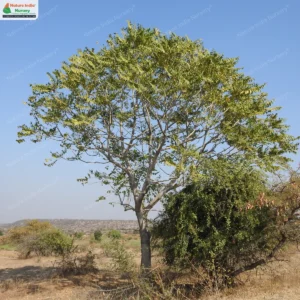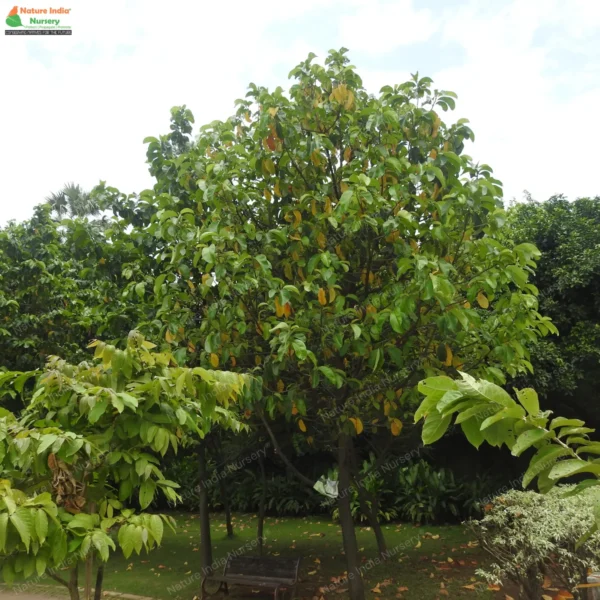
Artocarpus lacucha is a medium to large deciduous tree belonging to the mulberry family, Moraceae. It is valued for its edible fruits and is native to the Indian subcontinent and parts of Southeast and East Asia. The species is commonly known as Monkey Jack and is also referred to as Lakoocha or Badahar in different regions.
The tree can grow up to approximately 20 metres tall, developing a broad, spreading crown. Its bark is dark and fissured, while young branches are often covered with soft, rusty or reddish-brown hairs. The leaves are simple, alternate, broadly elliptic to oblong, with a rough upper surface and a softly hairy underside.
The species bears separate male and female flower heads on the same tree. The male flower heads are small and yellowish-orange, while the female flower heads develop into rounded, fleshy multiple fruits. Mature fruits are generally yellow, irregularly rounded and may reach about 4–10 cm in diameter. The ripe pulp is edible and has a sweet-sour flavour.
Habitat
Artocarpus lacucha grows in tropical and subtropical forests, particularly in moist valleys, forested hills and along stream banks. It occurs naturally across parts of India, the Himalayan region, Bangladesh, Myanmar, Thailand, Laos, Vietnam and southern China. It is also cultivated in some areas for its fruits.
Planting and Care
- Light: Grows well in full sunlight; young plants can benefit from partial shade.
- Soil: Prefers fertile, well-drained soil with good organic matter.
- Watering: Requires regular watering during establishment. Once established, it can tolerate some seasonal dryness.
- Climate: Suited to warm tropical and subtropical conditions, particularly areas with a seasonal monsoon.
- Maintenance: Provide sufficient space for its spreading crown. Remove dead or damaged branches when necessary.
- Propagation: Commonly propagated through seeds extracted from ripe fruits.
Additional Information
- Edible Fruit: The ripe fruit is eaten fresh and is also used in regional preparations such as pickles, chutneys and curries.
- Traditional Uses: Different parts of the tree, including the bark, leaves and fruit, have been used in traditional systems of medicine. These historical uses should not be taken as evidence of established clinical effectiveness.
- Ecological Value: The fleshy fruits provide food for wildlife, while the tree contributes to the structure and diversity of tropical forest habitats.
- Other Uses: The tree is valued locally for its wood and can be planted as a fruit-bearing shade tree.
- Flowering and Fruiting: The timing varies with location and climate; flowering and fruiting may occur over an extended season in some parts of its range.